RFP automation
An RFP, answered from the content your team already approved
This page is the workflow rather than the pitch: what happens to a 200-question request between the buyer sending it and your response going back, who touches it, and where every claim is drawn from.
What happens between the RFP landing and the response going back
Five steps. Your SMEs only really work in the fourth one, and the fifth is the one that stops two answers contradicting each other in front of an evaluator.
- 01
Intake, and the bid decision
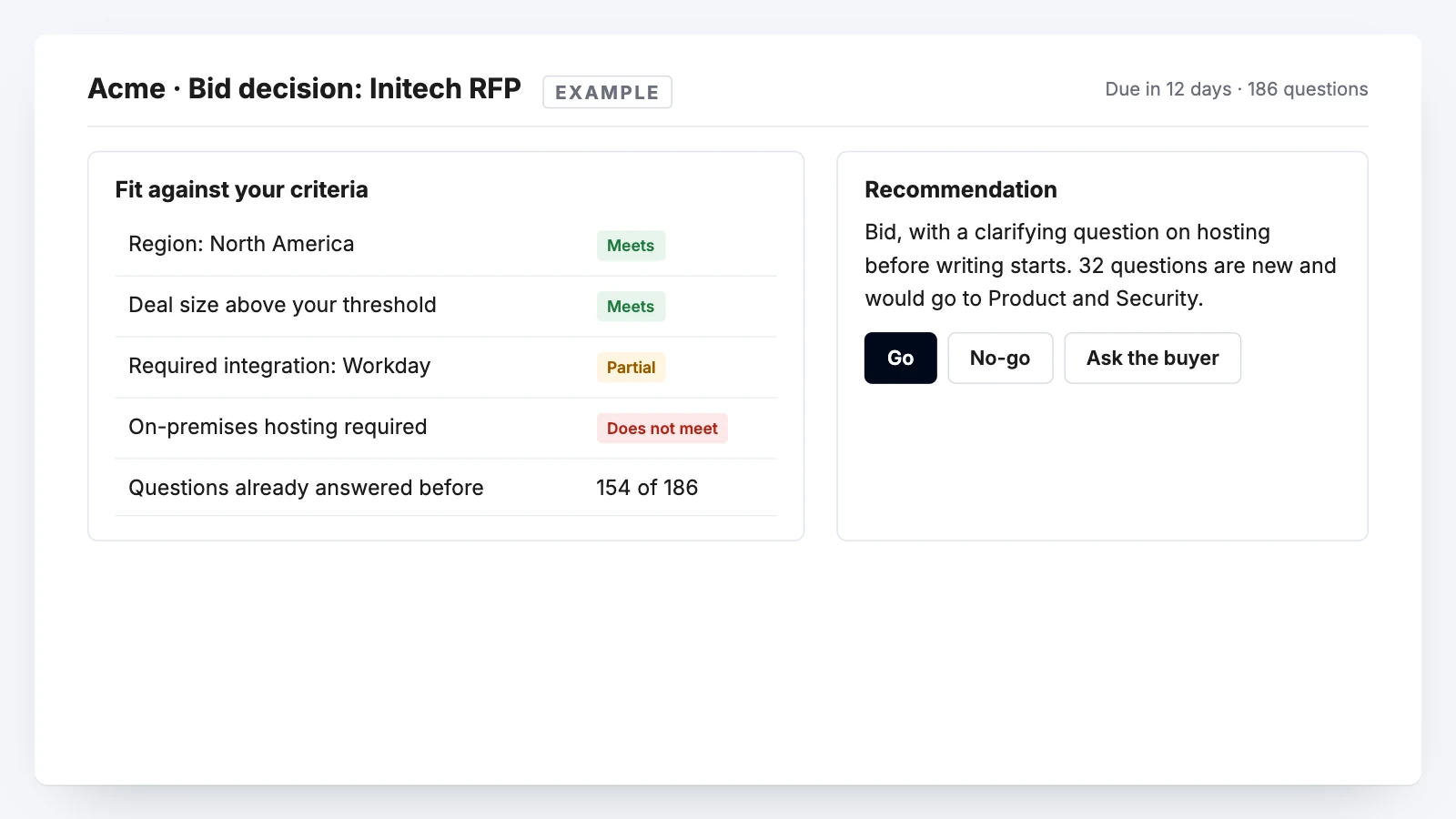
XLSX, DOCX, PDF, a portal export. The questions come out of the file and sort themselves by section, so you can see the shape of the work before anyone commits a week to it.
- 02
Retrieval from approved sources
Each question goes to the proposals you have already won, the product documentation, the policies, the call notes and the CRM record. Not a library somebody remembered to update last quarter.
- 03
A draft with the source attached
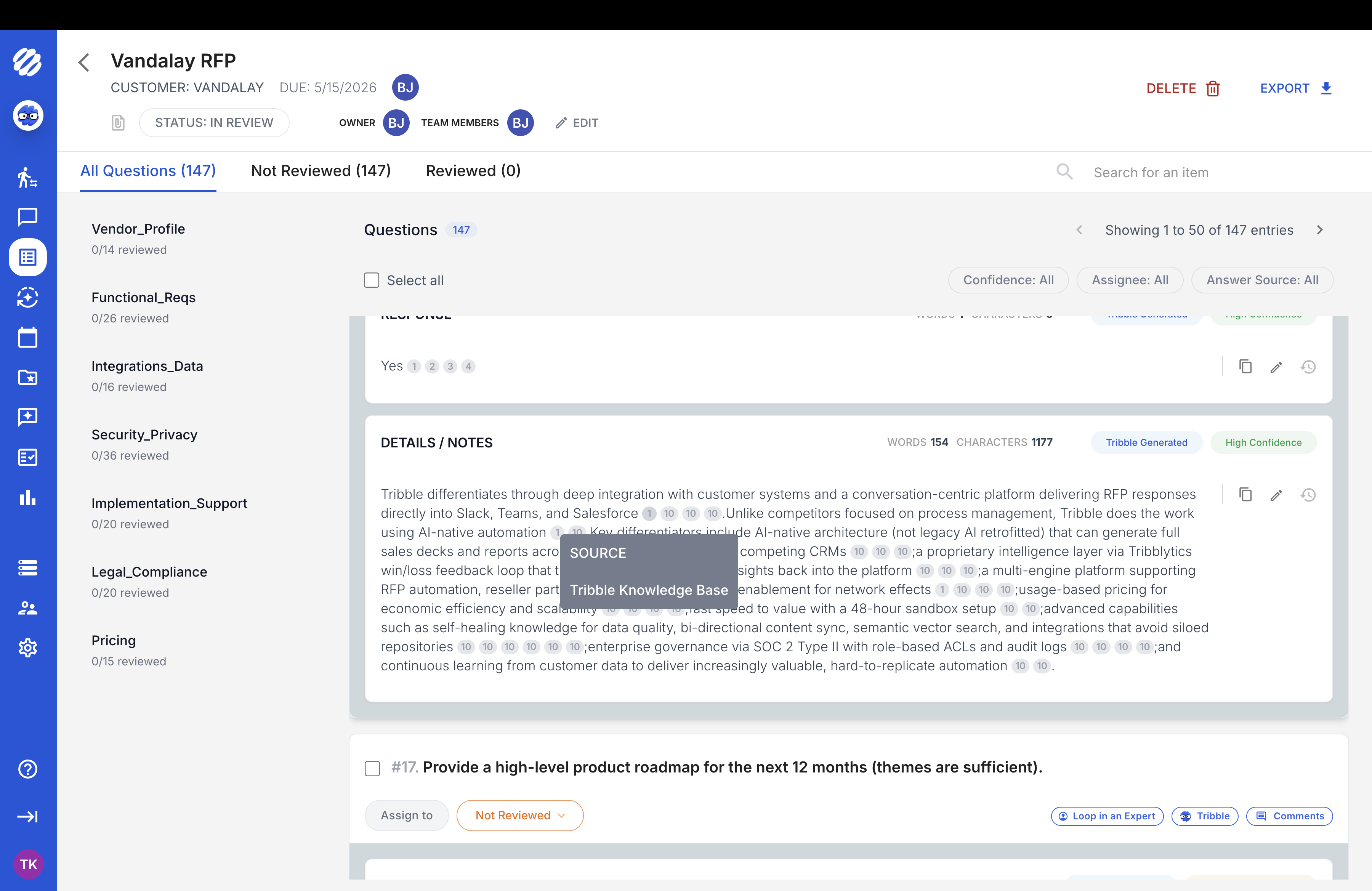
Every answer names the document behind it and how sure it is. It is written for the buyer in front of you, with their industry and their risk posture, rather than being the last answer reheated.
- 04
Expert review where review is needed
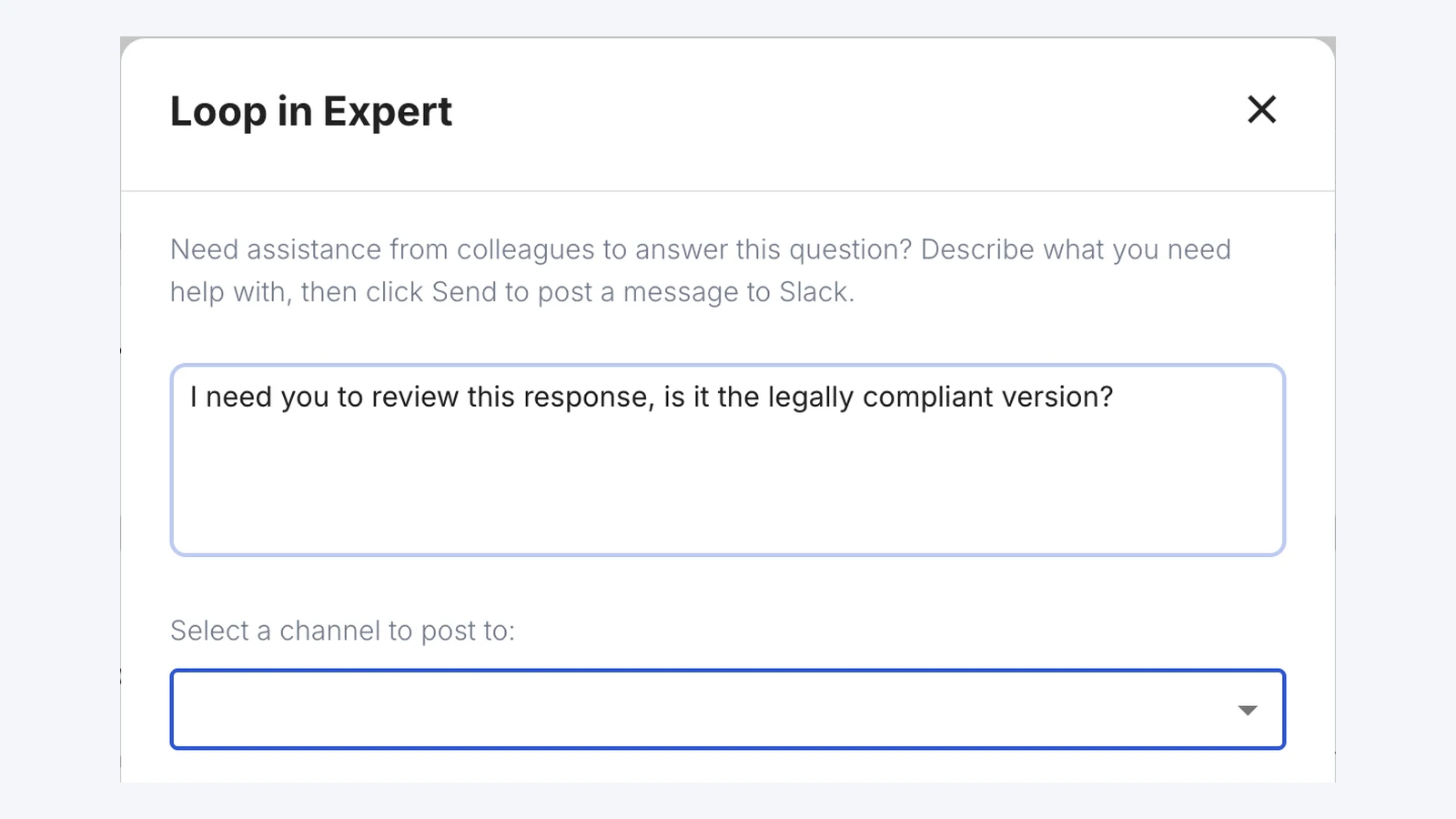
Low-confidence answers route to the person who owns them in Slack or Teams. Everything else comes back ready, so your SMEs read the hard ten percent instead of proofreading the other ninety.
- 05
Consistency check, then submit
Contradictions across the full response get caught before an evaluator finds them. Export in the buyer's format, and the approved answers feed the next RFP.
What a sourced answer gets you that a stored one does not
Six things, and the first three are the reason the other three are possible.
Written for this buyer
The answer reflects their industry, their risk posture and what the deal record says they care about. A stored answer reflects whoever last had time to edit it.
Evidence under every claim
Each answer names the document it was drafted from. When legal asks where a number came from, the answer is a link rather than an afternoon.
Review only where review is needed
Confidence is scored per answer. Your SMEs read the ten percent that needs a human and stop proofreading the ninety that does not.
Nothing contradicts anything else
A consistency check runs across the full response. Two answers can each be correct and still disagree, and an evaluator reading both at once is the worst place to find that out.
It improves per submission, not per refresh
Reviewer decisions and win and loss outcomes feed back. A library improves when somebody schedules time to improve it.
No content migration first
It reads from Salesforce, SharePoint, Drive, Confluence, Notion and Gong where the content already is. Permissions carry over, so nobody sees evidence they could not already open.
What it accepts
The structure is parsed out of the file. A buyer who invented their own format is the normal case, not the exception.
The sections of an enterprise RFP, and where each one goes wrong
Most of a response is not hard. The six areas below are where responses are lost, and each fails in a specific, repeatable way.
Company, references and financials
"Describe your company, your ownership structure, and provide three references in our industry."
Drawn from the approved company record and the reference list sales actually maintains, so the entity name, the headcount and the certifications match the ones in the legal section. The reference names come from the current list, not from the version pasted into the last four responses.
Where it goes wrong Three different headcounts across one response, because three people answered three sections on three different days.
Functional and technical requirements
"For each requirement, state whether the capability is standard, configurable, on the roadmap, or unavailable."
Answered against current product documentation rather than a sales deck. Where the honest answer is configurable or roadmap, it says so, because an overstated yes surfaces in the pilot and costs more than the question was worth.
Where it goes wrong A yes written eighteen months ago against a capability that shipped differently, found by the evaluator in a reference call.
Security, privacy and compliance
"Provide your SOC 2 report, describe encryption at rest and in transit, and detail your incident response process."
Routed to the same approved security evidence a standalone questionnaire uses: the current report, the current certification scope, the policies as they are written now. One source of truth for both surfaces, so the RFP and the security review cannot disagree.
Where it goes wrong The RFP answer and the security questionnaire answer, sent two weeks apart by two teams, describing different retention periods.
Implementation, support and SLAs
"Describe your implementation methodology, timeline, and the support model including response time commitments."
Drafted from the methodology services actually runs and the SLA legal actually signs. Commitments route to the owner before submission, because this is the section that becomes a contract schedule.
Where it goes wrong An implementation timeline written by the proposal team that services has never agreed to and cannot hit.
Pricing and commercial terms
"Provide pricing for the configuration described, including all third-party costs and a three-year total."
Left to the people who own it, with the structural work done: the question is parsed, routed and tracked so nothing is missed. Tribble does not invent a number, and a response where it did would be worse than one with a gap.
Where it goes wrong A pricing table answered in isolation that contradicts the licensing model described in the functional section.
Legal, contractual and insurance
"Confirm acceptance of the attached terms, or detail every exception with your proposed alternative language."
Matched against the positions legal has already taken on the same clauses in previous responses, with the prior language attached. Exceptions are drafted from your standard positions rather than from scratch under deadline.
Where it goes wrong A clause accepted in the RFP that legal would never accept in redlines, found at contract stage with the deal already committed.
90% of a 200-question RFP completed in under an hour
The numbers below are from response teams running this workflow on their own content.

How this differs from what you are probably using
Three alternatives, described as their users would describe them rather than as a competitor would.
| Tribble Respond | Static answer library | Legacy RFP platform | ChatGPT or Claude | |
|---|---|---|---|---|
| Where the answer comes from | Retrieved live from your approved sources | An answer somebody wrote and has to maintain | Stored historical responses | Whatever you pasted into the prompt |
| Source attribution | Every answer names its source document | A manual reference, if someone added one | A manual reference, if someone added one | No way to check where it came from |
| Confidence scoring | Scored per answer, before review | None | None | None |
| Consistency across the response | Contradictions caught before submission | None | None | None |
| Expert routing | Routed by question type in Slack or Teams | Whoever you remember to ask | In-app review queue | Whoever you remember to ask |
| Stays current | Reads the source, so it moves when the source does | Only when someone runs a content refresh | Only when someone updates the stored answer | Only within the one conversation |
| Learns from outcomes | Reviewer decisions and win and loss data feed back | None | Usage analytics only | Nothing persists |
| Permissions | SSO, RBAC, source permissions respected | Whatever the document store enforces | Platform roles | Whatever was pasted in |
The questions a proposal lead asks on the first call
Not the objections a vendor prepares for. The ones that decide whether this is worth a pilot.
"We already have an answer library. What does this replace?"
The maintenance, mostly. A library is a snapshot that needs a refresh project to stay true; this reads the sources, so an updated policy is an updated answer with no content project in between. If your library is genuinely current and your team is happy maintaining it, the honest answer is that the gain here is smaller.
"How do I know it will not make something up?"
Because every answer names the document it came from and what it could not find, it fails visibly rather than fluently. An answer with no source is flagged as having no source. That is the difference from a general-purpose model, which will always produce something that reads well.
"My SMEs will not read AI output."
They are not asked to. They see the answers that scored low and the source behind each one, which is review rather than proofreading. The complaint under this question is usually that SMEs are sent 200 questions when forty needed them.
"What happens on the questions we genuinely cannot answer?"
They come back marked as uncovered rather than filled in. Seeing the gap before you commit to the bid is the useful output, and it is the same parse that tells you whether the RFP is worth responding to at all.
The pattern across all four is the same: the value is not drafting speed, which every tool in this category claims. It is that a sourced answer can be checked, and a stored or generated one cannot.
Where it reads from
The content stays where it is. Permissions come with it.





Questions that come up before a first RFP
The ones asked on nearly every call.
What is RFP automation software?
RFP automation software parses an incoming questionnaire, retrieves approved answers, drafts responses, routes reviewers and exports in the buyer's format. Tribble adds the part that decides whether the output is usable: every answer names the source document it was drafted from and carries a confidence level, so reviewers verify evidence rather than read unattributed text. A consistency check runs across the whole response before submission, and completed RFPs feed back into the answer layer.
How is this different from a static RFP answer library?
A library stores answers somebody wrote once and has to maintain by hand. Tribble retrieves from the sources themselves, which means the answer reflects the current policy, the current product documentation and the current security posture without a content refresh project. The library model also cannot tell you why an answer is in it; a sourced answer can show you.
What file formats does it handle?
XLSX, DOCX, PDF, Google Sheets and Docs, a buyer's own spreadsheet with no standard structure, and direct intake from vendor portals. The question and answer structure is parsed automatically, so a bespoke format works the same way as a standard one.
How do we know the answers are accurate?
Each answer carries the source document it was drafted from and a confidence level. Low confidence routes to the owner before submission rather than after. The consistency check is the second half of accuracy and the half most tools skip: two answers that are each individually correct can still contradict each other across a 200-question response.
Does it work with the systems our content already lives in?
Salesforce, HubSpot, SharePoint, Google Drive, Confluence, Notion, Box, Slack, Microsoft Teams and Gong. There is no content migration step. Permissions are respected, so nobody retrieves evidence they could not already open themselves.
How long does it take to run a first RFP?
The work is connecting the sources your team already uses and deciding who owns review for which section. Teams usually start with one live RFP and one set of sources, then widen once the review routing is right.
Can it decide whether we should bid?
It gives you what the decision needs rather than making it. The questions are parsed and sorted before any drafting happens, so you can see how much of the response your approved content already covers and where the gaps are, which is the input a bid or no-bid call actually turns on.
How does pricing work?
Annual platform editions based on response volume, included projects and enterprise requirements. The pricing page carries the current structure.
Read next
The other response workflows this runs on.
Security questionnaires
SIG, CAIQ, VSA and a buyer’s own spreadsheet, answered from approved evidence.
DDQ automation
Investor and operational due diligence, answered from fund documentation.
Long-form responses
Executive summaries and narrative sections, not just question and answer grids.
Portal and chat intake
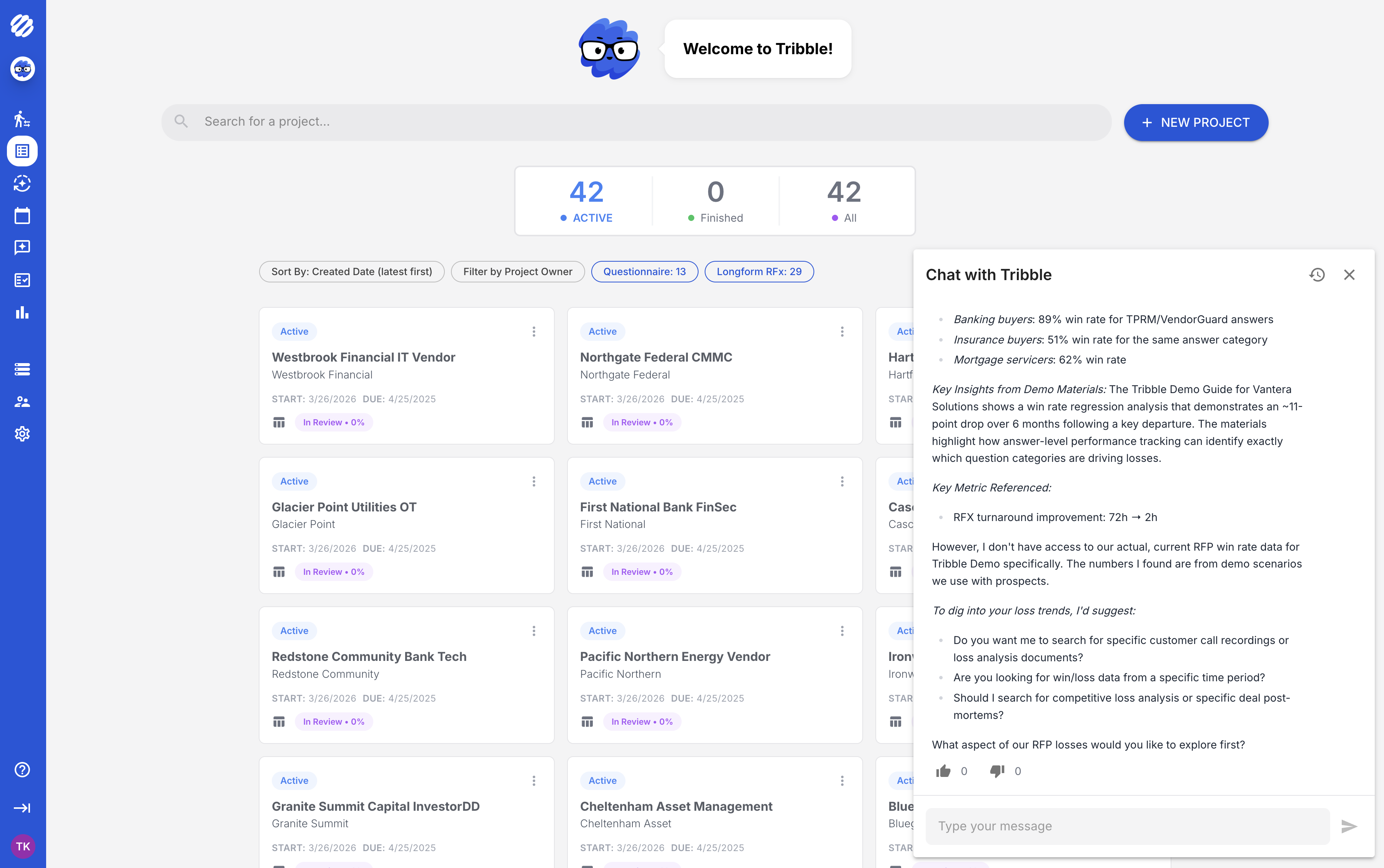
Questions answered where they are asked, in Slack, Teams or a vendor portal.
ROI calculator
Run your own volumes rather than ours.
Tribble Respond
The product all five workflows run on.